

Google's AI Mode Cited VibeFlow. Here's What That Means.
Three days after shipping the schema and entity-graph work, Google's AI Mode started citing VibeFlow as a source for our own brand-name queries. Correlation, not causation — but the receipt arrived faster than I expected.
I searched my own brand name in Google's AI Mode this morning. The AI Mode answer panel cited VibeFlow as a source — homepage, /about, Terms of Service — in the sidebar rail. Three days ago, that wouldn't have happened. The pages existed but the entity graph that tells the model who and what didn't.
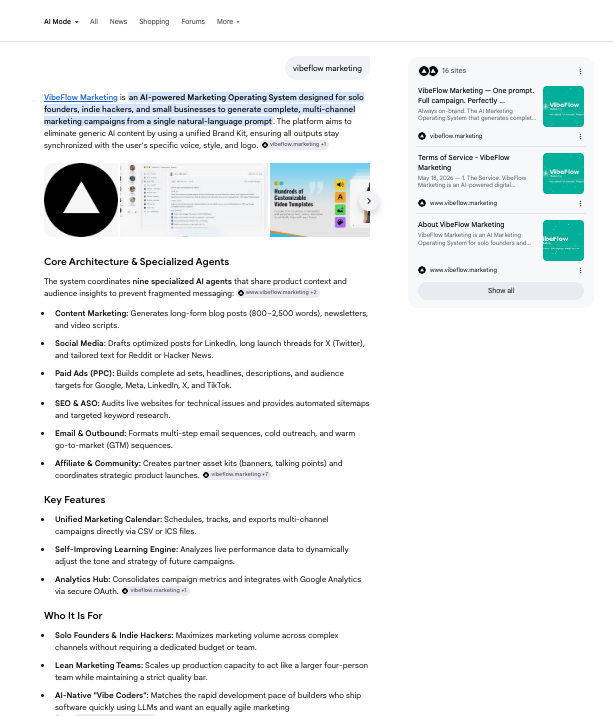
This is the post I couldn't write last week. Last week I had a hypothesis: ship the schema, the /about page, the opinionated /stack, and a model will cite you. This week the model cited us. The work didn't take six months to show up. It took three days.
A short post. A real receipt.
What's actually in the screenshot
Google's AI Mode shows the synthesized answer in the center column and a "sources" rail on the right. For the query "vibeflow marketing", the rail says 16 sites. At the top of the rail: three VibeFlow Marketing cards — our homepage, our Terms of Service, our /about page. The synthesized answer pulls from those sources by name — VibeFlow Marketing is an AI-powered Marketing Operating System designed for solo founders, indie hackers, and small businesses… — and the description traces almost word-for-word to copy on our homepage and /about.
Three pages cited. Zero clicks required. The user gets the answer in the AI Mode panel. Whether they click through depends on whether the answer leaves them wanting more — which is the new conversion question and a topic for a different post.
Why this is different from a page-one ranking
A page-one ranking gets you a spot in a list of ten blue links. The user scans, picks one, clicks. AI Mode collapses that into a single synthesized answer with three or four sources surfaced as cards. The other twelve sites that were "ranked" for that query become invisible.
Translation: ranking matters less. Being cited matters more. And the signals that drive citation are different from the signals that drove ranking.
I wrote about this in detail last week in Google Rewired Search. Here's What I Shipped in Five Days. — the full breakdown of the citation game vs. the ranking game, the four signals that decide which pages get cited, and the playbook I'd run if you're staring at the same problem. The TL;DR for here: server-rendered content, entity-graph schema, named authorship, opinionated non-commodity content. Each one signals to the model that the page is safe to quote and easy to anchor.
What we shipped that probably did it
The five changes from the Rewired Search post — recapped briefly here because if you're going to claim a citation receipt, you should be specific about what could have produced it:
- Entity-graph JSON-LD — Organization, SoftwareApplication, WebSite, Person (linked to my real social profiles via
sameAs), BlogPosting withdateModifiedon every post. The model can now verify what entity this is and who wrote it. /aboutwithAboutPageschema andmentionslinking back to the SoftwareApplication@id. The canonical answer surface for "what is VibeFlow."/stackwith opinionated tool picks andItemListschema. Citable as a curated recommendation, not a commodity roundup./learn/seorewritten with first-hand framing and a clear point of view, while the other seven primers stay on the template as a control group.- AI Search Audit in the SEO agent — the audit mode that checks whether your pages are citable by AI Overviews, not just ranked. Internally called
evaluate_ai_search.
For the why behind each one — the specific schema decisions, what AboutPage actually does, why opinionated roundups beat listicles — see the Rewired Search post. It has the technical rationale; this post has the receipt.
I can't prove any single one of those caused the citation. I can prove that we shipped them on Monday and Google's AI Mode was citing us by Wednesday. That's the sequence. Take it as correlation if you want — it's what I have.
What this validates
The entity-graph work. If the model is treating us as a knowable entity worth citing, it's because the schema let it. Without Person + sameAs + linked-to-SoftwareApplication, an AI Mode answer about VibeFlow has nothing to anchor to. A page hero is not enough. A Twitter bio is not enough. The structured graph is what the model reads, and it shows up in the citation rail.
Also the /about page. AboutPage schema isn't optional anymore — it's the surface for entity-knowledge queries. Without it, the model would have either skipped us or used homepage marketing copy, which would have read as positioning instead of definition.
The hypothesis on /stack and /learn/seo is still open. Neither is showing up yet for the queries I want them to win — "best email tool for indie founders," "what is SEO marketing." That data needs more days. I'll post when it's real.
What's next
Three things on the watch list:
Citation tracking for competitor queries. Brand-name citation is the easy case. The harder case is when someone searches "AI marketing tools for solo founders" and an AI Mode answer either cites VibeFlow or doesn't. That's the citation rate I want to track week over week.
Primer rollout. If /learn/seo starts winning AI Mode citations in the next two weeks, the other seven /learn primers get the same rewrite. If it doesn't, that's data too.
The trust feature. Our own Content agent now runs every generation through a deterministic fabrication check + a Sonnet-powered cleanup pass before delivering output. That's the feature I shipped between the previous post and this one — Fact Guard, how I stopped my AI from making stuff up has the full architecture. The work to make our own content trustworthy is the same work that makes content citation-worthy. Same standard, applied internally.
We didn't prove anything. We shipped, we got the receipt, we keep shipping. The work is small. The window for being early is not.
Ship marketing as fast as you ship code.
VibeFlow turns one prompt into a full launch — content, social, SEO, ads, ASO, email. Free to try.
Start free →